team.dhavalvyas@gmail.com
30 Crypto Strategies — Know Your Entry, Your Exit, and When to Stay Out
By Dhaval vyas
Free
By Dhaval vyas
Free


You know how to read a chart. The problem is what happens next.
Where exactly do you get in? Where do you get out if you're wrong? And which conditions mean you shouldn't take the trade at all?
Tick the offer at checkout and add three more of my trading books for just ₹1:

Most trading material shows you the setup and stops there. This book covers the entry, the exit and when to stay out — for 30 complete crypto strategies across BTC, ETH and major altcoins.
Each chapter follows the same 16 sections in the same order, so you always know where to look:

The rules are written to be checked, not interpreted. Where a decision genuinely needs judgement, it's labelled as judgement instead of being disguised as a rule.
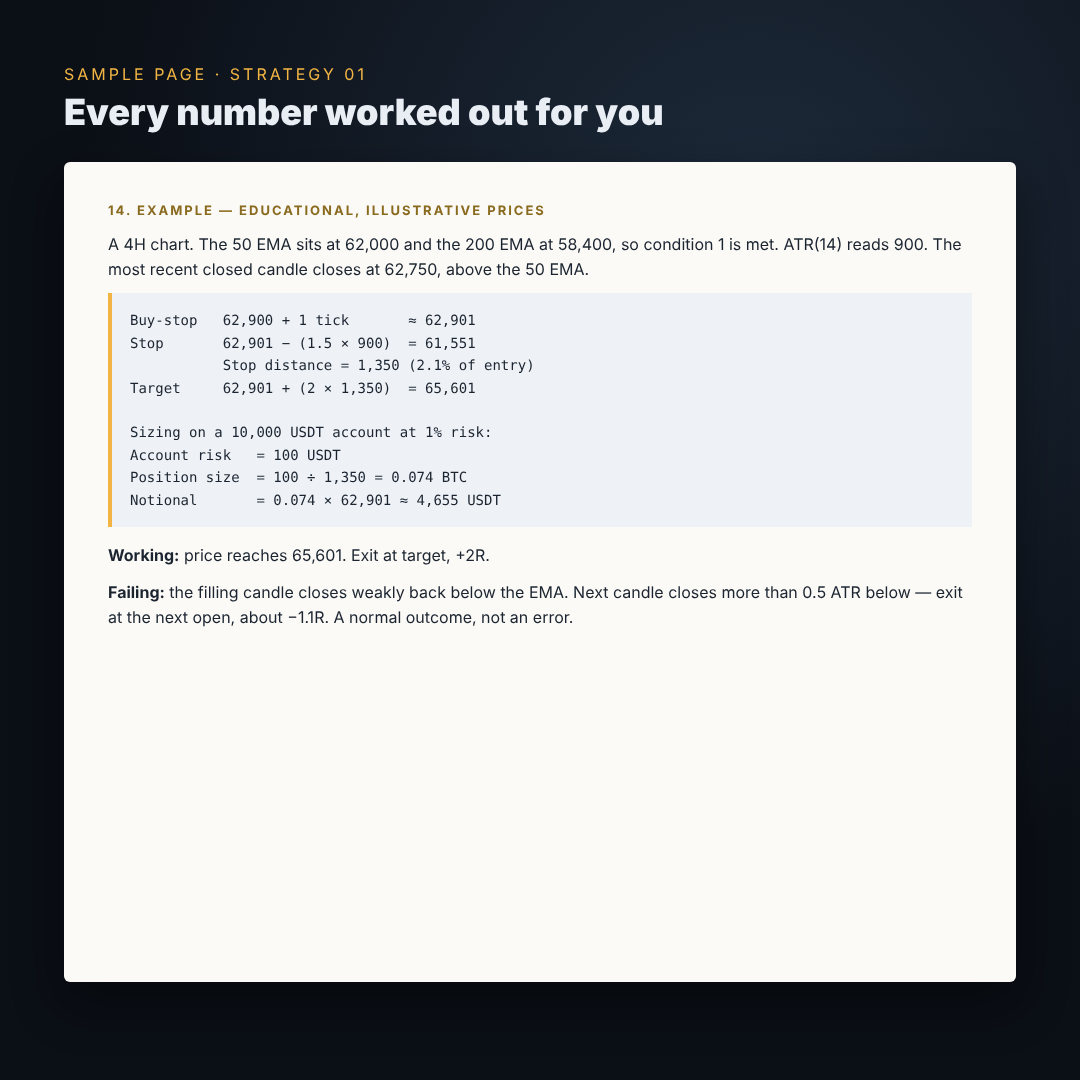
Section 12 of every chapter is "When Not to Trade." Section 13 is the failure mode — written before you place the order, not after you've lost on it. Every chapter's diagrams show the setup going wrong, given the same weight as the setup going right.

Part I — Trend & Continuation
01 Trend Pullback to EMA
02 Momentum Expansion
03 Daily Trend, 1H Trigger
04 Trend Resumption After Squeeze
05 Time-Series Momentum
Part II — Breakout & Expansion
06 BandWidth Squeeze Breakout
07 Donchian 20 Breakout
08 UTC Opening Range Breakout
09 Previous-Day High/Low Break
10 Breakout Retest
Part III — Pullback & Mean Reversion
11 Bollinger Reversion
12 RSI Extreme Reversion
13 Anchored VWAP Reversion
14 ATR Extension Reversal
15 Range Fade
Part IV — Structure & Reversal
16 Swing Sweep Reversal
17 Failed Breakout Reversal
18 Prior-Level Rejection
19 Structure Break + Retest
20 Daily Compression Expansion
Part V — Momentum & Volume
21 Relative Volume Breakout
22 Volume Dry-Up Continuation
23 Volume Climax Reversal
24 OBV Divergence
25 VWAP Reclaim on Volume
Part VI — Crypto-Specific & Multi-Factor
26 Basis Extreme Reversal
27 Open Interest Expansion
28 Flush & Reclaim
29 Dominance-Filtered Alt Trend
30 Three-Factor Regime Setup
Plus Part VII: a strategy decision tree, a comparison matrix across all 30, the strategy pairs that must never run on the same instrument, the full risk management playbook, and a do-not-trade framework.
Part VI uses things that only exist in crypto — perpetual futures basis, open interest, liquidation dynamics and Bitcoin dominance — and states plainly what that data can and cannot tell you.
10 Pine Script v6 indicator and alert scripts designed to help you monitor selected setups on TradingView — Strategies 01, 02, 05, 07, 11, 12, 14, 21, 22 and 23.
They are indicators, not automated trading systems. They mark setups — the decision stays yours.
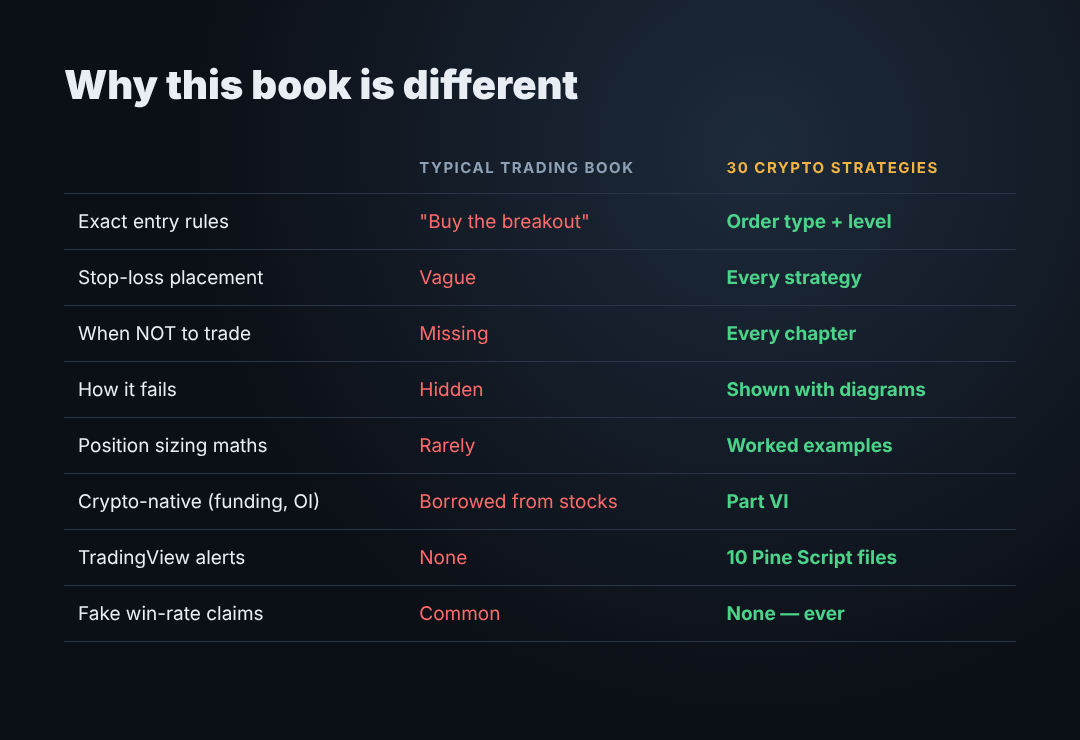
There is no win rate, profit factor, return figure or backtest result anywhere in these pages. That is deliberate. What the book gives you instead is the thing that has to come first: rules precise enough to follow, test yourself, and abandon when the evidence says so.
Questions about format, delivery, TradingView plans or refunds? See the FAQ below.
Crypto products and NFTs are unregulated and can be highly risky. There may be no regulatory recourse for any loss from such transactions.
Educational material, not financial advice. Nothing here is a recommendation to buy or sell any asset. Trading cryptocurrency involves substantial risk of loss, and leveraged products such as perpetual futures can lose more than you commit. All charts are illustrative and do not show historical performance. You alone are responsible for your trading decisions.
